Business process automation has been a priority for organizations for decades, but the emergence of AI agents powered by Large Language Models (LLMs) is fundamentally changing what’s possible. Unlike traditional automation tools that follow rigid rules, AI agents can understand context, make decisions, and adapt to changing conditions. In this article, we’ll explore five key ways these intelligent agents are revolutionizing business process automation.
1. Handling Unstructured Data and Natural Language
The Challenge: Traditional automation tools excel at processing structured data but struggle with unstructured information like emails, documents, images, and natural language conversations. This limitation has kept many knowledge work processes resistant to automation.
The AI Agent Solution: AI agents can process, understand, and generate natural language, allowing them to extract relevant information from unstructured sources, interpret requests, and communicate in a human-like manner.
Real-World Example: A financial services company uses AI agents to process customer emails, automatically categorizing requests, extracting relevant account information, and either resolving simple issues or routing complex ones to the appropriate department with all necessary context.
2. Making Complex Decisions
The Challenge: Traditional automation requires explicit programming for every decision point in a process. This becomes impractical for workflows with numerous variables or nuanced judgment calls.
The AI Agent Solution: AI agents can evaluate multiple factors, weigh different considerations, and make decisions based on both explicit criteria and learned patterns. They can handle exceptions and edge cases without requiring predefined rules for every scenario.
Real-World Example: An insurance company uses AI agents to review claims, analyzing policy details, claim information, and historical data to determine approval paths, identify potential fraud indicators, and calculate appropriate payouts for straightforward cases.
3. Adapting to Changing Conditions
The Challenge: Business processes often need to adapt to changing circumstances, but traditional automation tools are rigid and require manual reconfiguration when conditions change.
The AI Agent Solution: AI agents can monitor conditions, recognize when circumstances have changed, and adjust their approach accordingly. They can learn from new data and feedback to continuously improve their performance.
Real-World Example: A supply chain management system uses AI agents to monitor global shipping conditions, automatically rerouting shipments and adjusting procurement schedules when disruptions occur, without requiring manual intervention for each scenario.
4. Bridging System Gaps
The Challenge: Many organizations struggle with disconnected systems and data silos that make end-to-end process automation difficult or impossible.
The AI Agent Solution: AI agents can work across different systems, translating and transforming data as needed. They can extract information from one system, process it according to business rules, and input it into another system, effectively serving as intelligent middleware.
Real-World Example: A healthcare provider uses AI agents to bridge the gap between their electronic health record system, billing software, and insurance portals, automatically transferring and transforming patient data to ensure accurate billing and reduce administrative overhead.
5. Augmenting Human Workers
The Challenge: Many knowledge work processes require a combination of routine tasks and complex judgment that has been difficult to automate effectively.
The AI Agent Solution: AI agents can handle the routine aspects of processes while collaborating with human workers on tasks requiring nuanced judgment. They can prepare information, generate drafts, and provide recommendations for human review.
Real-World Example: A law firm uses AI agents to review contracts, highlighting potentially problematic clauses, suggesting alternative language based on precedents, and preparing summaries for attorney review, dramatically reducing the time required for contract reviews.
The Future of Business Process Automation
As AI agent technology continues to mature, we’re seeing a fundamental shift in what’s possible with business process automation. Processes that were previously considered too complex, dynamic, or judgment-dependent for automation are now prime candidates for AI-powered workflows.
The most successful organizations will be those that strategically deploy AI agents to handle routine and moderately complex tasks while enabling their human workforce to focus on high-value activities requiring creativity, emotional intelligence, and strategic thinking.
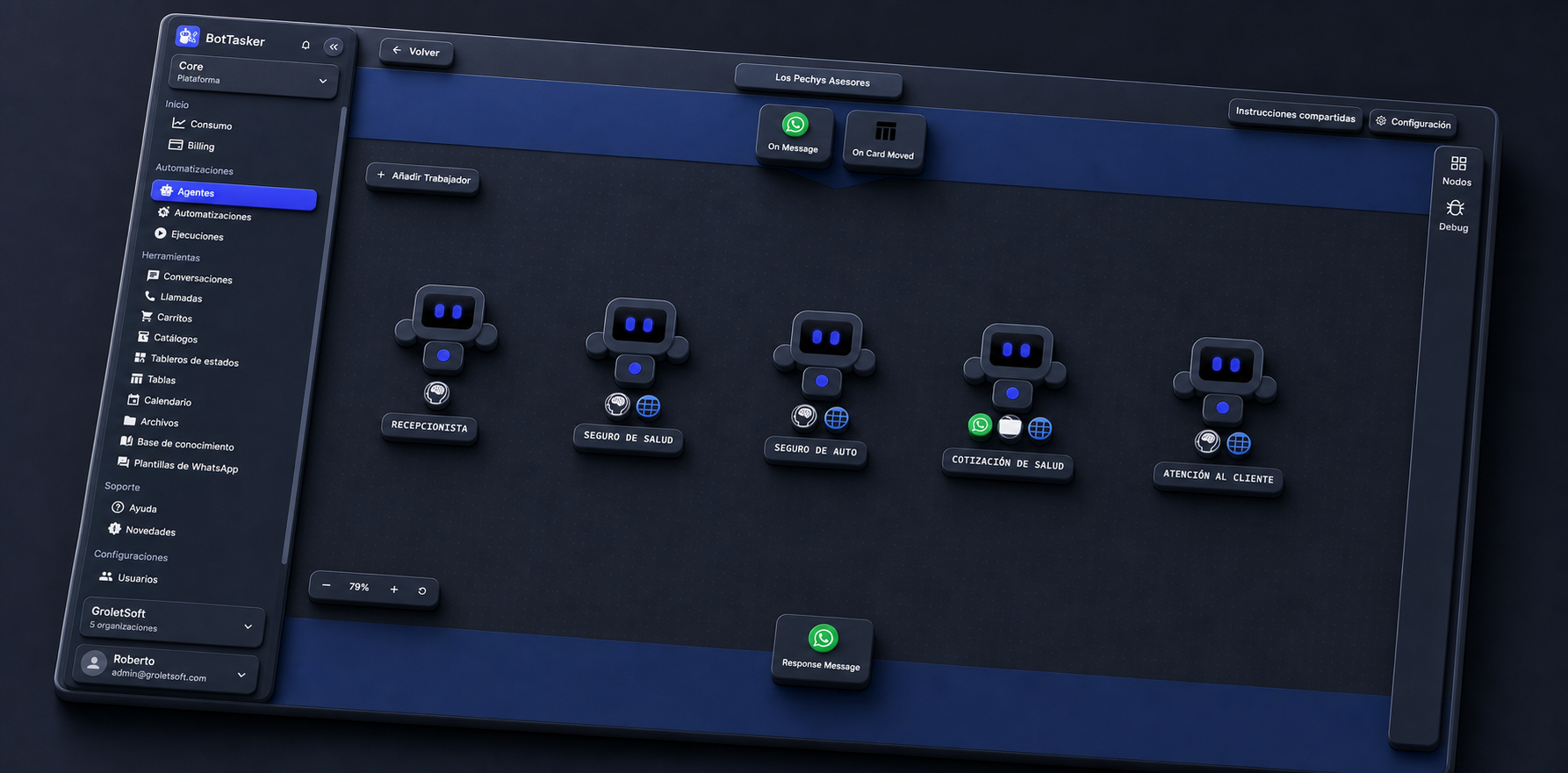
With platforms like BotTasker making it easier than ever to design and deploy AI agent-powered workflows without deep technical expertise, businesses of all sizes can now access these transformative capabilities.